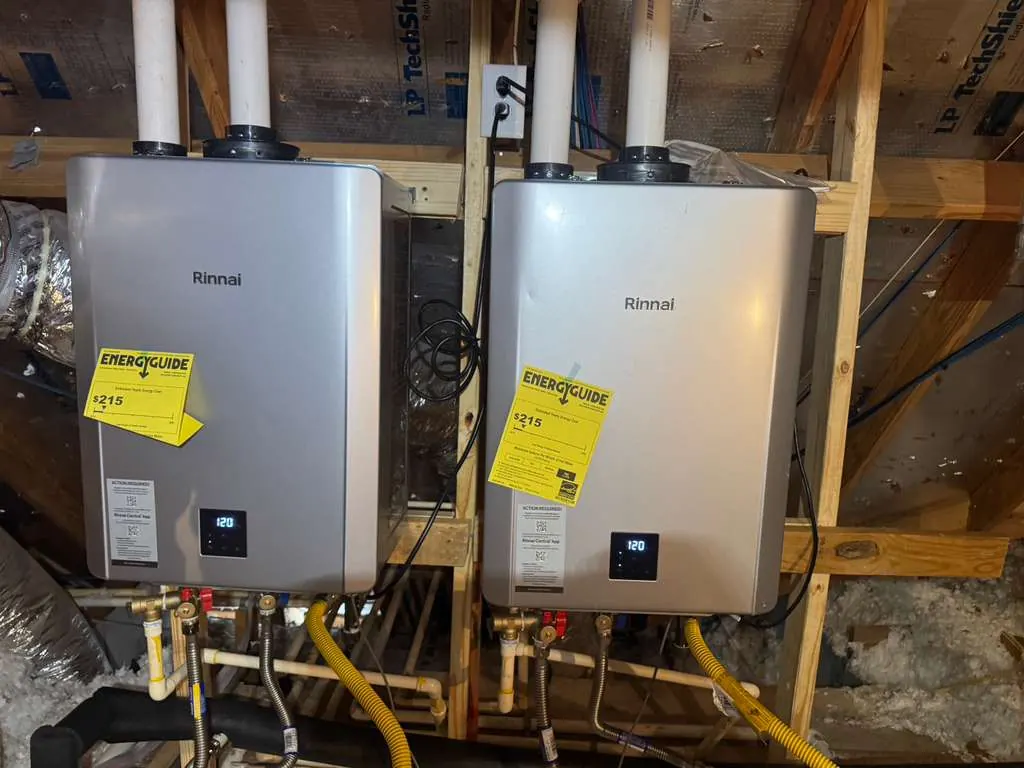
Tank or tankless for a large Chesterfield home? The honest answer depends on three numbers: your household’s simultaneous hot water demand, the layout of the house, and how long you plan to stay. Here is the comparison our technicians walk through on sizing visits, with the math done for how West County households actually live.
Step 1: Count Your Simultaneous Demand
Flow beats capacity on busy mornings. ENERGY STAR’s tankless buying guidance lists the reference figures: a shower runs about 2.5 GPM, a clothes washer about 3.3 GPM, bathroom and kitchen sinks about 2.2 GPM, and a dishwasher about 1.3 GPM, per ENERGY STAR. Add up the fixtures your worst simultaneous moment uses, add margin, and that number is what the tankless unit must deliver at our groundwater temperature.
| Scenario (large home, busy morning) | Demand | What handles it |
|---|---|---|
| Two showers running | ~5.0 GPM | One large tankless unit, properly sized |
| Two showers plus dishwasher | ~6.3 GPM | High-capacity tankless or paired units |
| Showers, laundry, kitchen all at once | 8+ GPM | Paired tankless units; recirculation loop helps delivery |
Step 2: Weigh the Real Differences
Endless supply versus finite tank
A tank heats its stored volume, recovers, and heats again; back-to-back baths in a big household will eventually outpace it. A right-sized tankless heats as it flows, so the fifth shower is as warm as the first. That is the headline feature, and it is real.
Lifespan and space
Tankless units commonly outlast tanks by years when maintained, and they mount on a wall, freeing floor space in utility rooms and closets. Tanks are simpler to swap and cost less up front; that is their whole pitch, and it is a fair one.
Efficiency, honestly
Standby losses make tankless the efficiency winner on paper. In practice the savings are modest: ENERGY STAR’s published savings figure for certified gas tankless over comparable storage units is around twenty dollars a year for a family of four. Buy tankless for supply and lifespan; treat fuel savings as a tiebreaker, not the thesis.
Step 3: Account for Our Water and Your Layout
Two local factors shape the decision more than brochures admit. First, our mineral-rich regional water rewards tankless owners who flush annually and punishes those who skip it; the annual descaling routine is part of the total cost of ownership here. Second, big footprints with distant master suites reward recirculation loops, which can be added to either system but pair naturally with tankless installs.
The Verdict for Chesterfield’s Large Homes
Homes with three or more baths, heavy simultaneous use and a long ownership horizon: properly sized tankless, often as paired units, with flush ports and a recirculation loop. Homes with moderate demand or an imminent-move horizon: a quality tank, flushed annually, replaced on schedule. And when the existing tank is mid-life and behaving, the best upgrade is the one you defer. When you want the math run for your specific house, our tankless installation team does sizing visits without the sales pressure, and the water heater repair side keeps tanks honest as long as they deserve it.
The Maintenance Reality Check for Both Systems
Neither system is maintenance-free, and the maintenance is where local water writes the rules. A tank wants an annual flush to clear the sediment layer that hardens on its floor, plus an anode rod check every few years to keep corrosion aimed at the sacrifice metal instead of the steel. Skip both and the tank that should serve a decade limps through seven. A tankless unit wants its annual descale, a rinse of inlet screens and a venting glance; skip that and the heat exchanger chokes gradually until flow and temperature complaints arrive together. Neither schedule is heavy: each is roughly one quiet service visit a year, and each protects the efficiency that justified the purchase. The honest difference is consequence. A neglected tank tends to announce itself with leaks and replacement; a neglected tankless tends to throttle itself slowly and repairably. Households that genuinely will not maintain anything should factor that into the tank versus tankless decision before the equipment makes the decision for them.One more angle worth weighing if a move is anywhere on your horizon: water heating shows up in inspections and buyer questions. A documented, professionally maintained system, whichever type, reads as care; an aging, sediment-rattling tank reads as an upcoming negotiation item. Whichever direction you choose, keeping the service records turns the equipment from a question mark into a line item you control.